
Adult Empowerment Program (IDD support)

Empowering Adults with Disabilities
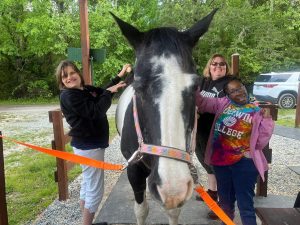
Joining our Adult Empowerment Program offers a unique opportunity for Adults with Intellectual and Developmental Disabilities (IDD) to not only have fun, but to learn critical life skills in an experiential, hands on farm environment.

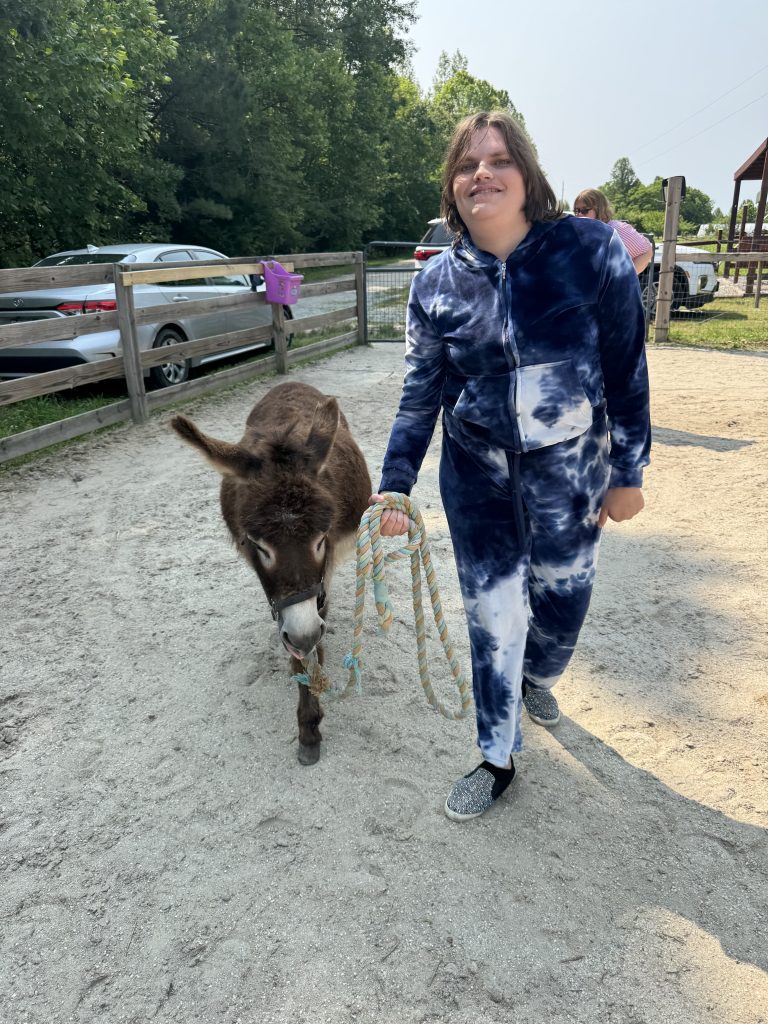
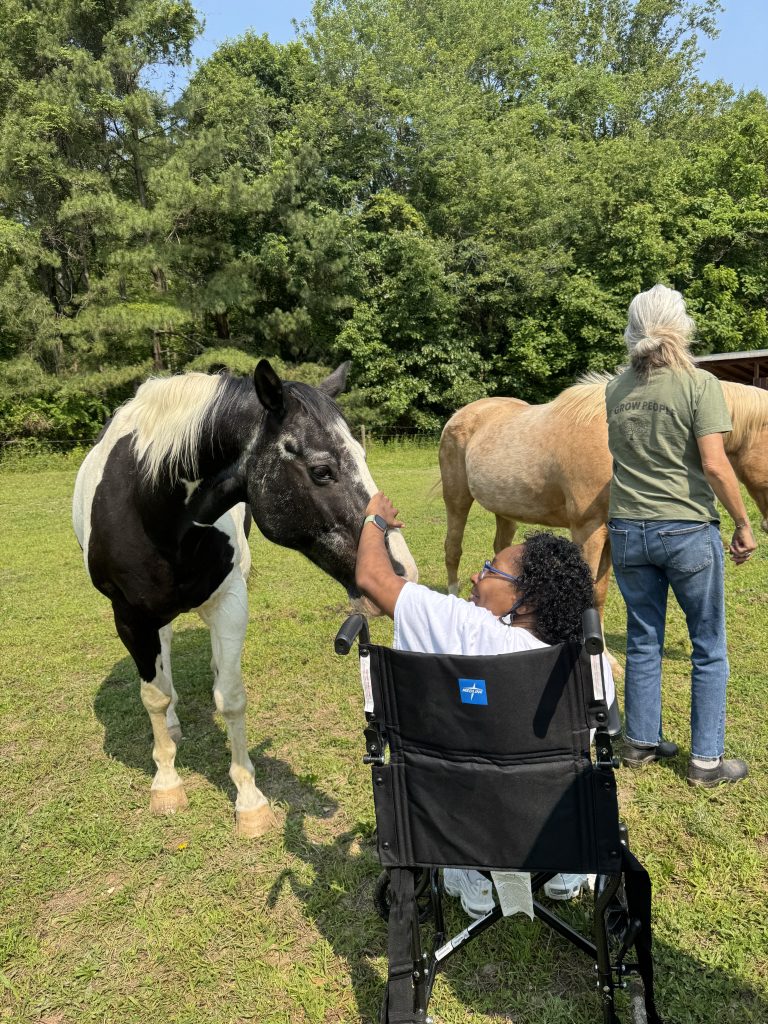
Each week, participants come to the farm in groups of 3-4 people for 1-2 hours, to spend time with our horses, donkeys, goats, chickens, our pet pig Sassy and more. During this time, participants learn how to groom the horses, clean the donkey pen, fetch chicken eggs, harvest vegetables in our Community Garden, hold baby goats and in the process, learn transferable life skills. When working with horses in particular, participants receive immediate feedback, similar to the busy motions of the ‘real’ world.

Here at Fox Moon Farm, learning life skills is just part of the work we do. Building community and helping clients develop confidence, a sense of belonging and purpose is just as important. Our clients learn that actions matter and contributions are meaningful and promote self-worth, self-advocacy, self-discovery and a sense of dignity.

Guided by participant’s unique interests, our fun and interactive program helps clients develop everyday life skills, while fostering engagement and teamwork!
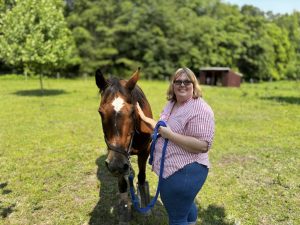
During each session, we teach essential behavioral, intellectual, and interpersonal skills needed to live a fulfilling and productive life, regardless of ability level. Often referred to as psychosocial skills, they can be categorized into three main groups:

  1. Emotional Skills: These involve self-awareness, managing emotions appropriately, and showing empathy.
  2. Social Skills: These focus on effective communication, building healthy relationships, and interacting successfully with others.
  3. Thinking Skills: These encompass problem-solving, openness to learning, and creative thinking.

Developing these skills can enhance connections with others and lead to a more satisfying life.

Benefits

–  Build social skills
Interacting with horses provides opportunities to tune into subtle social cues, which are crucial in everyday interactions. Horses communicate through body language, helping individuals with IDD learn to read non-verbal signals more effectively. Additionally, horses are sensitive to human emotions, and provide immediate feedback, helping participants learn cause and effect.

– Problem solving
Participants face real-life situations while working with our animals, which require in-the moment thinking and creative problem-solving, enhancing their ability to navigate similar unexpected challenges in daily life.

– Teamwork and collaboration                             Working together on farm projects fosters teamwork-encouraging the group to communicate effectively, share responsibilities and rely on one another.

– Physical experiences
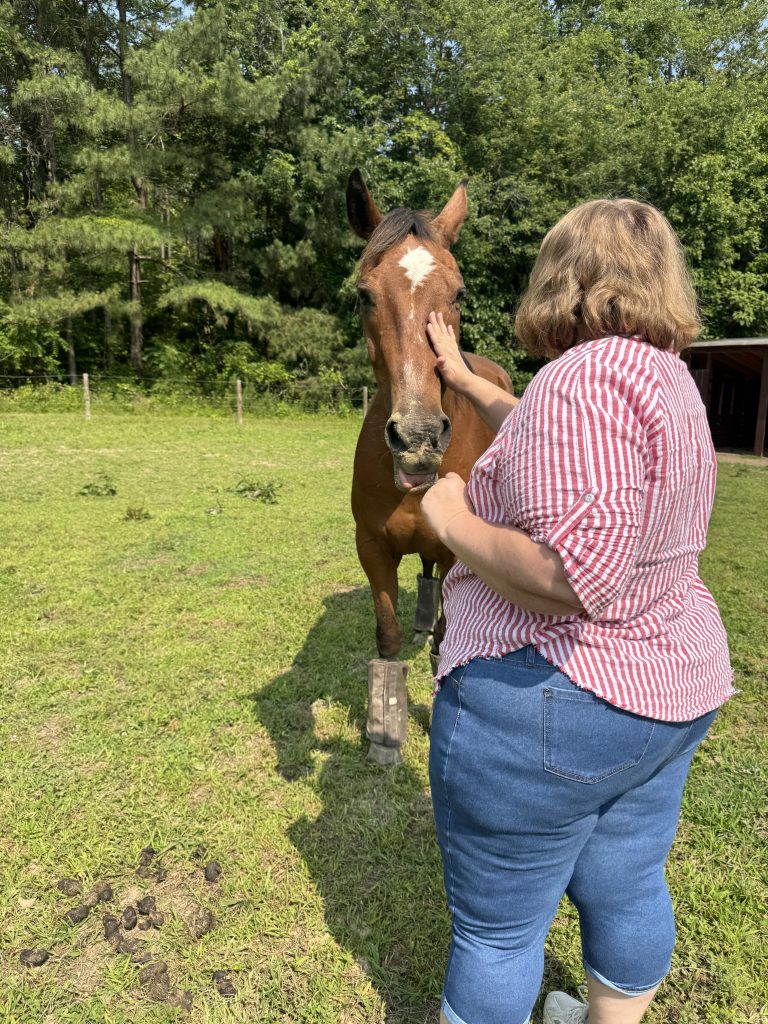
Working with horses and in nature fosters physical activity, coordination and motor skill development. The ever-changing environment of nature provides opportunities for exposure to different sensory experiences!
– And more!
Book an Adult Empowerment Session!

If you would like to learn more about our IDD group-based programming, please fill out the form and we will get back to you as soon as possible!

    We are on Facebook

    Comments Box SVG iconsUsed for the like, share, comment, and reaction icons

    There's a moment that happens over and over again at Fox Moon Farm, and we never get tired of watching it.

    A child stands at the pasture fence, sure they can't climb it. Or stares at a halter, sure their hands won't figure out the buckle. Or looks up at a horse — enormous, powerful, nothing like them — and is sure, absolutely sure, that this isn't for them.

    So many of our kids arrive carrying that certainty. They've spent years being told, in a hundred small ways, that they're different — that they don't move through the world the way other kids do, don't learn the way the classroom expects, don't look or sound or act like what's "typical." That adds up. It settles into a child's sense of self long before they have words for it.

    Here, we don't start with big lessons. We start with small, achievable tasks — climbing the pasture fence, hooking a halter, jumping off a rock, grooming a horse, learning to drive the tractor. Nothing flashy. Just one thing, right at the edge of what feels possible.

    And when they do it — when the halter clicks, when their feet land on the other side of that fence — we celebrate. Loudly. High-fives, real "good jobs," the kind of recognition that says we saw that, and it mattered.

    Confidence isn't built in a single triumphant moment. It's built task by task, the same way trust is built with a horse — slowly, and only through proof. Every small win here becomes evidence a child can carry with them: I did the thing I didn't think I could do. That evidence adds up to something society hasn't handed them: the belief that they are capable.

    That's the work. One fence, one halter, one hoof pick at a time.
    ... See MoreSee Less

    Theres a moment that happens over and over again at Fox Moon Farm, and we never get tired of watching it.A child stands at the pasture fence, sure they cant climb it. Or stares at a halter, sure their hands wont figure out the buckle. Or looks up at a horse — enormous, powerful, nothing like them — and is sure, absolutely sure, that this isnt for them.So many of our kids arrive carrying that certainty. Theyve spent years being told, in a hundred small ways, that theyre different — that they dont move through the world the way other kids do, dont learn the way the classroom expects, dont look or sound or act like whats typical. That adds up. It settles into a childs sense of self long before they have words for it.Here, we dont start with big lessons. We start with small, achievable tasks — climbing the pasture fence, hooking a halter, jumping off a rock, grooming a horse, learning to drive the tractor. Nothing flashy. Just one thing, right at the edge of what feels possible.And when they do it — when the halter clicks, when their feet land on the other side of that fence — we celebrate. Loudly. High-fives, real good jobs, the kind of recognition that says we saw that, and it mattered.Confidence isnt built in a single triumphant moment. Its built task by task, the same way trust is built with a horse — slowly, and only through proof. Every small win here becomes evidence a child can carry with them: I did the thing I didnt think I could do. That evidence adds up to something society hasnt handed them: the belief that they are capable.Thats the work. One fence, one halter, one hoof pick at a time.

    How do you measure joy?

    It's not a number on a chart. It's not something you can graph or quantify in a quarterly report. But if you spent a day here at Fox Moon Farm, you'd see it everywhere — and you'd understand exactly what we mean.

    It's the moment a child who struggles to make eye contact looks straight into the eyes of a horse and doesn't look away. It's the quiet pride on a teenager's face after they've mucked a runnin from start to finish, all by themselves. It's a grown adult, laughing out loud, because a goat just decided they were their new best friend.

    We serve children and adults of every age and every ability here. They come to us for a hundred different reasons — trauma, anxiety, sensory processing differences, grief, isolation. But underneath all of it, they're looking for the same thing: a little more joy. A little more peace. A place where they're accepted exactly as they are.

    So how do we measure it? We measure it in the acts of kindness we see between strangers who just met an hour ago. We measure it in bare feet running through the grass because — for once — nobody's watching to see if they're doing it "right." We measure it in the deep exhale that happens when someone finally feels safe enough to just be.

    Joy doesn't always look like a big moment. Sometimes it's small, quiet, and easy to miss. But we see it every single day — and we never stop being grateful for it.
    ... See MoreSee Less

    How do you measure joy?Its not a number on a chart. Its not something you can graph or quantify in a quarterly report. But if you spent a day here at Fox Moon Farm, youd see it everywhere — and youd understand exactly what we mean.Its the moment a child who struggles to make eye contact looks straight into the eyes of a horse and doesnt look away. Its the quiet pride on a teenagers face after theyve mucked a runnin from start to finish, all by themselves. Its a grown adult, laughing out loud, because a goat just decided they were their new best friend.We serve children and adults of every age and every ability here. They come to us for a hundred different reasons — trauma, anxiety, sensory processing differences, grief, isolation. But underneath all of it, theyre looking for the same thing: a little more joy. A little more peace. A place where theyre accepted exactly as they are.So how do we measure it? We measure it in the acts of kindness we see between strangers who just met an hour ago. We measure it in bare feet running through the grass because — for once — nobodys watching to see if theyre doing it right. We measure it in the deep exhale that happens when someone finally feels safe enough to just be.Joy doesnt always look like a big moment. Sometimes its small, quiet, and easy to miss. But we see it every single day — and we never stop being grateful for it.Image attachmentImage attachment+Image attachment

    🐴 A Milestone Worth Celebrating 🐴
    Yesterday brought one of those sessions that reminds us exactly why we do this work.

    One of our incredible young riders — a 17-year-old who lives with autism and works every day to navigate motor challenges, anxiety, and the world nonverbally — climbed up onto Merlin’s back for a brand-new challenge: threading rings onto cones and hanging them in the trees in the arena.

    It looks like a simple game. It isn’t. Every ring placed is a lesson in following multi-step directions, color recognition, fine motor control, and patience — skills that don’t always come easily, practiced here in a way that feels like joy instead of work.

    This rider has been part of our Healing with Horses community for over two years, and just recently graduated into our therapeutic riding program. And the growth has been remarkable. Grooming Merlin used to hold no interest at all — now it’s a ritual: twenty brush strokes on each side, every single time, before it’s time to tack up. That kind of focus, that kind of care for another living being, is something we get to witness grow week by week.

    Research consistently backs up what we witness on the ground every week: therapeutic horseback riding offers real, measurable benefits for individuals with autism. The horse’s rhythmic, three-dimensional gait mirrors human walking patterns and has a documented calming effect on the nervous system, helping to regulate sensory input and ease anxiety. Physically, riding builds core strength, balance, coordination, and body awareness. Behaviorally and emotionally, studies show reductions in irritability and hyperactivity alongside gains in social communication, focus, and self-confidence — many of these benefits proving durable months after sessions continue.

    We couldn’t be prouder of the courage, focus, and heart shown yesterday. And we’re deeply grateful to our team and to Merlin, our steady, patient partner in this work, for making moments like this possible.

    This is the power of nature and animals as healers. This is Fox Moon Farm Project. 🍂
    ... See MoreSee Less

    🐴 A Milestone Worth Celebrating 🐴
Yesterday brought one of those sessions that reminds us exactly why we do this work.One of our incredible young riders — a 17-year-old who lives with autism and works every day to navigate motor challenges, anxiety, and the world nonverbally — climbed up onto Merlin’s back for a brand-new challenge: threading rings onto cones and hanging them in the trees in the arena.It looks like a simple game. It isn’t. Every ring placed is a lesson in following multi-step directions, color recognition, fine motor control, and patience — skills that don’t always come easily, practiced here in a way that feels like joy instead of work.This rider has been part of our Healing with Horses community for over two years, and just recently graduated into our therapeutic riding program. And the growth has been remarkable. Grooming Merlin used to hold no interest at all — now it’s a ritual: twenty brush strokes on each side, every single time, before it’s time to tack up. That kind of focus, that kind of care for another living being, is something we get to witness grow week by week.Research consistently backs up what we witness on the ground every week: therapeutic horseback riding offers real, measurable benefits for individuals with autism. The horse’s rhythmic, three-dimensional gait mirrors human walking patterns and has a documented calming effect on the nervous system, helping to regulate sensory input and ease anxiety. Physically, riding builds core strength, balance, coordination, and body awareness. Behaviorally and emotionally, studies show reductions in irritability and hyperactivity alongside gains in social communication, focus, and self-confidence — many of these benefits proving durable months after sessions continue.We couldn’t be prouder of the courage, focus, and heart shown yesterday. And we’re deeply grateful to our team and to Merlin, our steady, patient partner in this work, for making moments like this possible.This is the power of nature and animals as healers. This is Fox Moon Farm Project. 🍂Image attachmentImage attachment+2Image attachment
    Load more

    Want news and updates?
    Sign up for our newsletter.

    Healing, Learning, and Growing Together: Empowering Lives through Horses, Community, and Wellness.